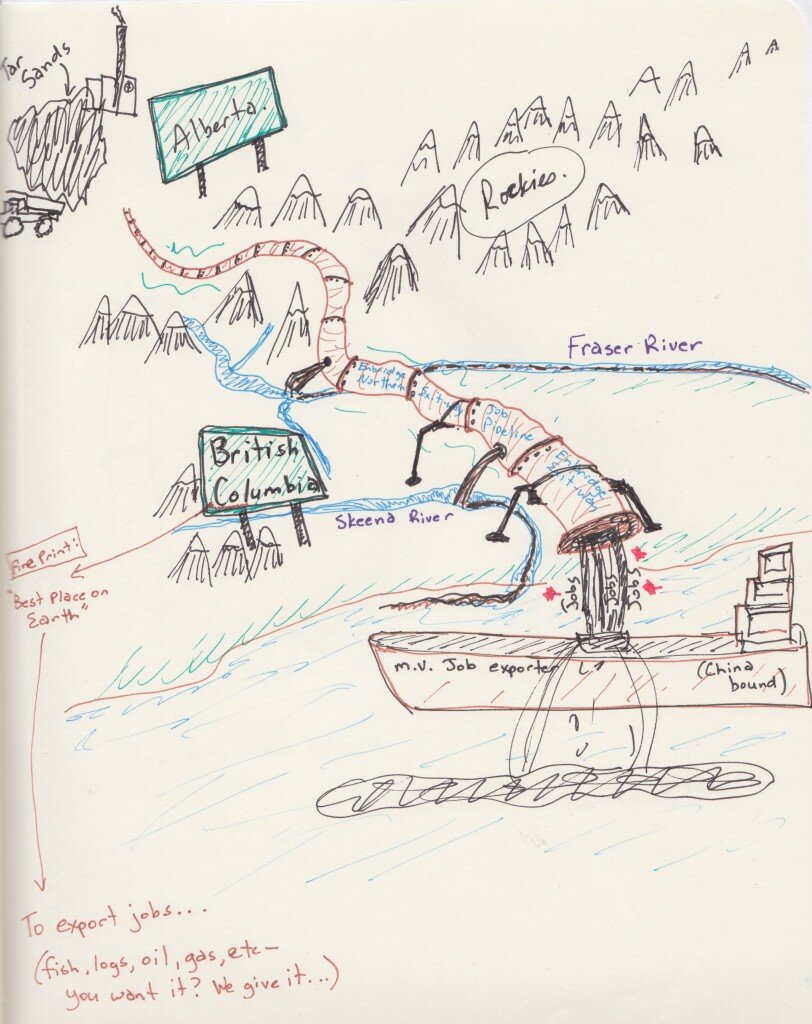
Anyone heard this story before?
 Another blown forecast for Fraser sockeye. Remember the 2009 Cohen Commission and about $25 million spent? How many of the recommendations have been implemented?

Salmon management Denial Train

Anyone heard this story before?
Another blown forecast for Fraser sockeye. Remember the 2009 Cohen Commission and about $25 million spent? How many of the recommendations have been implemented?
Salmon management Denial Train
Statistical methods do not prevent mistakes, faulty reasoning, incorrect conclusions, inaccuracies, or faulty use of statistics…
 Seems fitting when it comes to ‘salmon management’ or anything else that requires deep use of statistics… and worse yet… much reliance on those statistics.
This was a fun illustration that I had forgotten about… fitting as many communities fight to keep herring fisheries out of their waters.
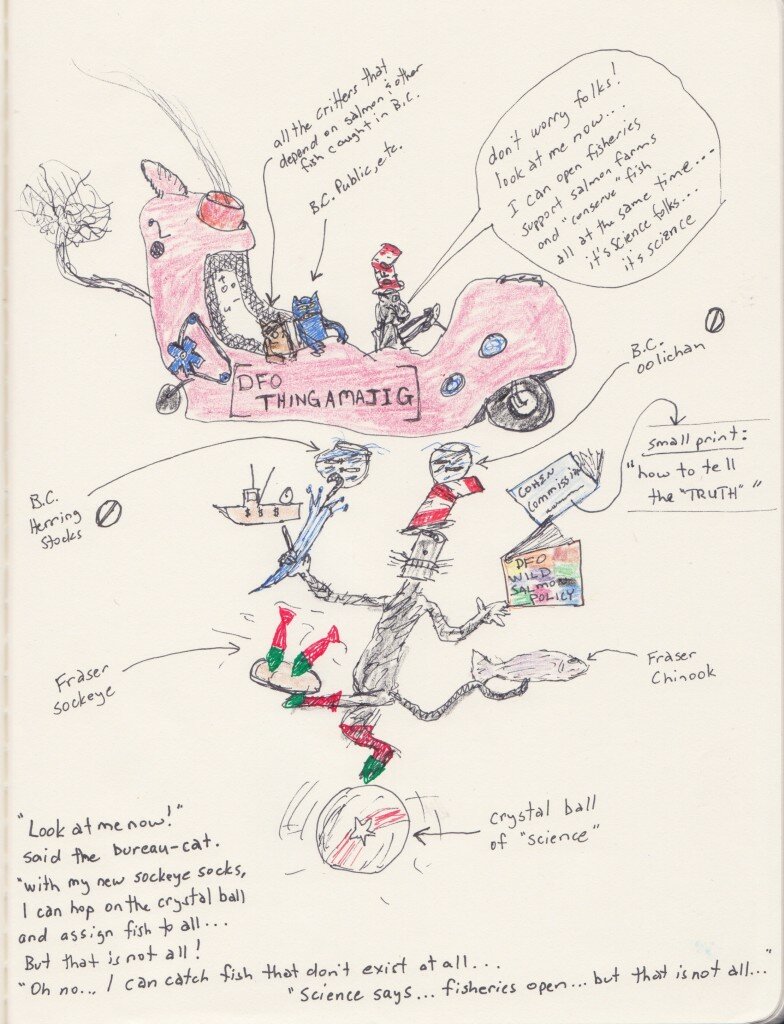
Fisheries & Oceans: thingamajig science
clever little comic in Prince George Free Press this week. Apparently, I’m not the only one with Enbridge marketing burnout… it’s everywhere, online, on CBC Radio One and Two… and it’s exhausting… and… well… laced with some pretty heavy BS-bitumen.
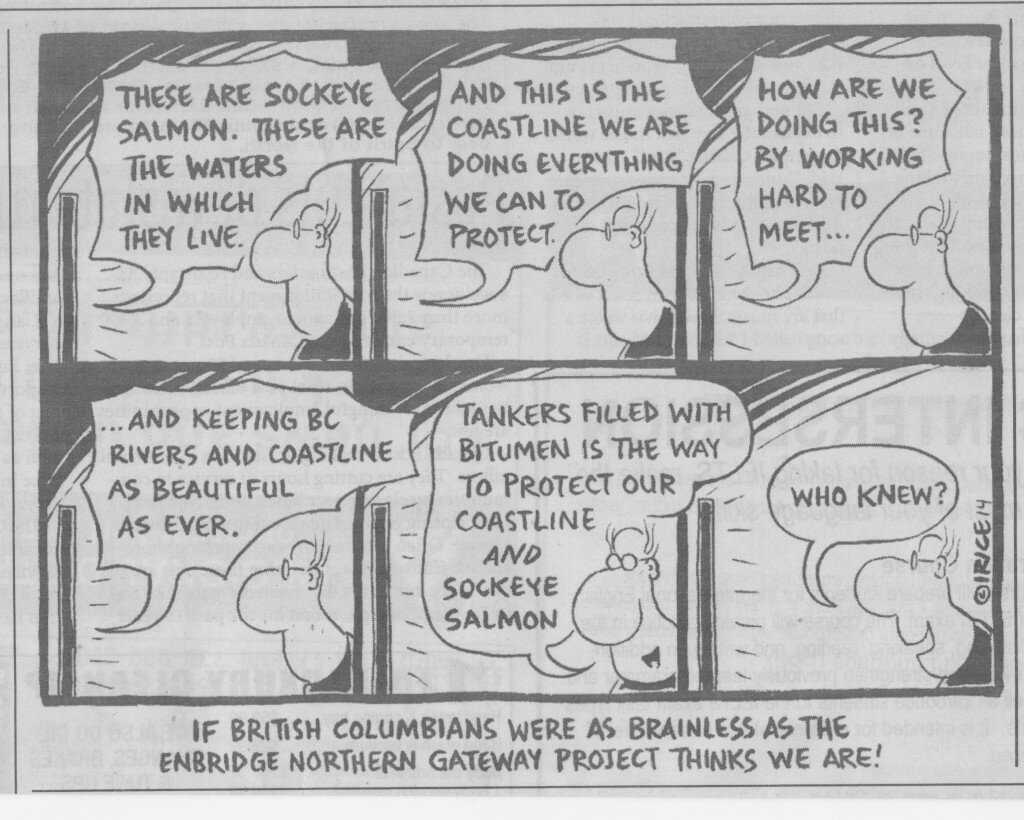
Prince George Free Press illustration – March 21, 2014
This 2nd is a small 6×6 piece that I did yesterday as a challenge from my significant other for an upcoming local art show that will be all 6×6 pieces…

policy unframework 1 (crayon and acrylic pain on canvas)
I’ve commented on this before – Orwell’s commentary on English language from his 1946 essay “Politics and the English Language”. In that essay he states:
Political language — and with variations this is true of all political parties, from Conservatives to Anarchists — is designed to make lies sound truthful and murder respectable, and to give an appearance of solidity to pure wind.
I recently came across an excellent new tool that can be employed by anyone in large organizations (or small). It was originally written up by Lew Gloin in a 1989 issue of Saturday Magazine produced by the Toronto Star. It’s called the “Systematic Buzz Word Generator”.
Take 30 carefully chosen bumpf-words, which may be employed at any moment to fluff up a report, memo, policy, or otherwise. Put the 30 words into three separate lists of ten words numbered 0 to 9. Then randomly choose any three digit number and select the corresponding bumpf-words to form a phrase.
For example:
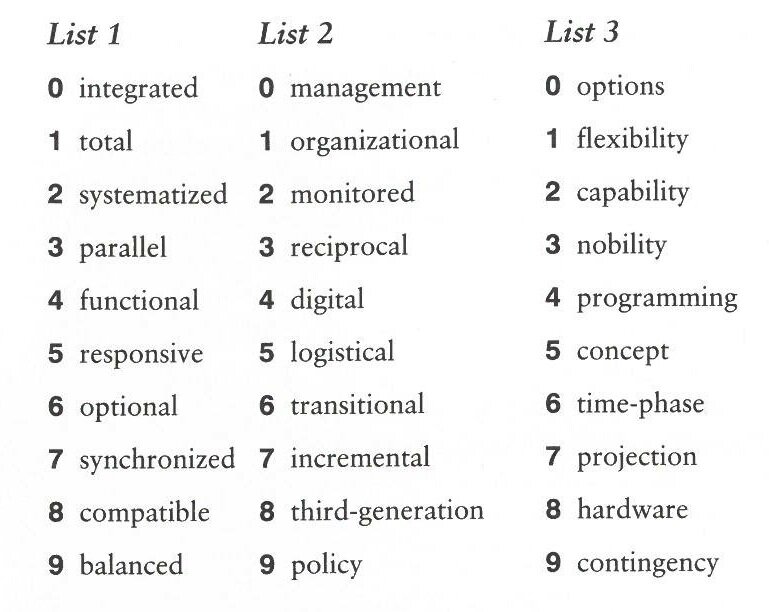 Thus, say the number 414 and you get “functional organizational programming” – who hasn’t heard that before?
Or, even 555 “responsive logistical concept” – probably pulled right from some government department strategic plan…
This is great stuff – and closely connected to the Bullshit Bumpf-word Bingo cards I produced on this site a few years ago.
From an on the Tyee website:
On Feb. 21, 2014, Federal Judge Leonard Mandamin ruled in favour of the injunction, noting that DFO’s decision to reopen the areas at a total allowable catch of 10 per cent instead of 20 per cent was, in his view: “fudging the numbers.”
“It is not science-based, but in effect a statement ‘there is a conservation concern here, but if the fishery is to be opened, take less,'” he wrote, noting that the DFO’s approach was used to sidestep the conservation assessment.
“It seems to me once the minister and the DFO depart from science-based assessments the integrity of fisheries management system is harmed,” the judge wrote.
This relates to a decision by the Federal Minister of Fisheries to set an arbitrary total allowable catch for herring on the west coast of Vancouver Island – this despite the fact that the areas have been closed for herring fishing since 2006 due to serious herring population concerns in those areas.
From another on the Tyee website referring to Minister Shea’s ‘political’ decision, over a ‘science-based’ decision.
This was revealed in an internal DFO document released yesterday during a court hearing of five Nuu-chah-nulth First Nations’ injunction against DFO’s proposal to reopen the west coast of Vancouver Island to commercial herring roe fisheries in 2014.
In a memorandum addressed to the minister on Dec. 9 2013, DFO scientists recommend maintaining the closure of the areas around the west coast of Vancouver Island, the central coast and Haida Gwaii for the 2014 fishing season.
Despite the advice, [Minister] Shea announced on Dec. 23, 2013 that the three areas would be reopened to commercial herring roe fisheries at a harvest rate of 10 per cent in 2014
Any surprise that that announcement was made a mere few days before one of the biggest holiday times of the year? (hmmmm).
This set of DFO decisions coming in light of the absolute failure to institute any of the changes recommended by the $25 million Cohen Commission investigating Fraser River sockeye populations.
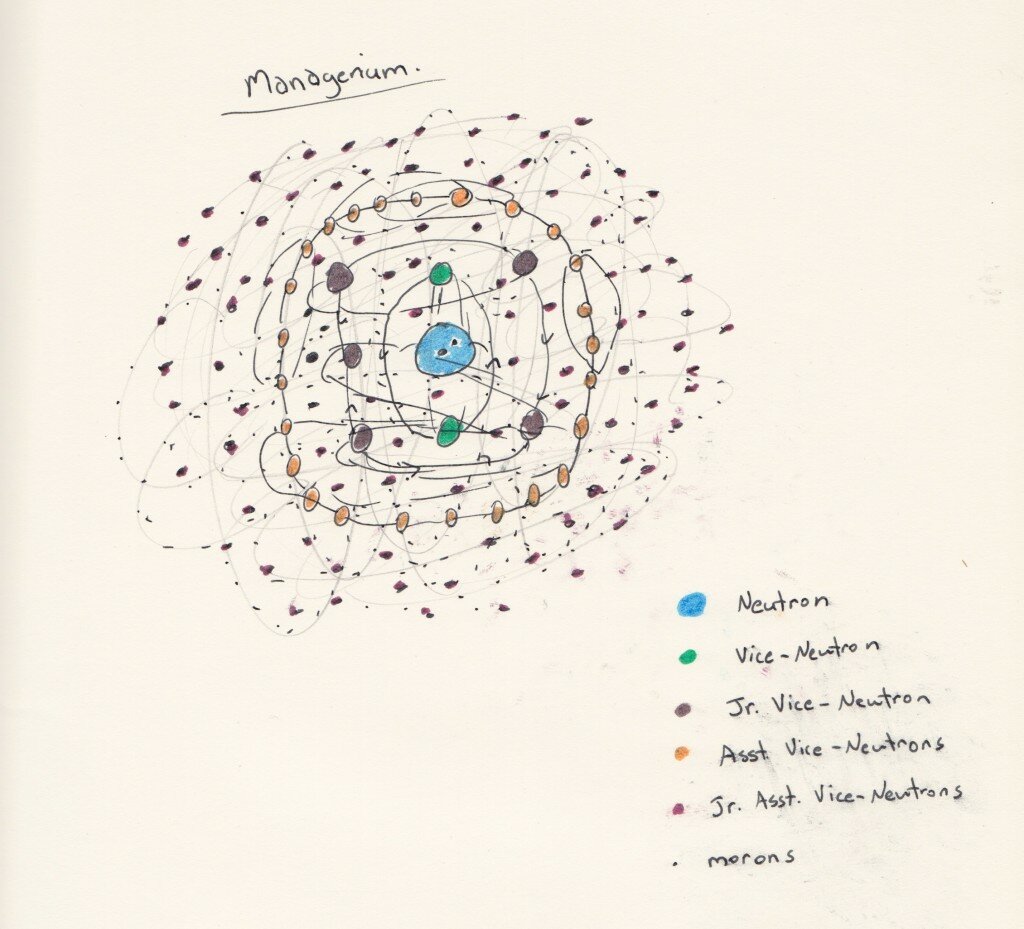
Managerium – new element on periodic table
Managerium – the heaviest element known to science.
This element has no protons or electrons, but has a nucleus composed of 1 Neutron, 2 Vice-Neutrons, 5 Jr. Vice-Neutrons, 25 Asst. Vice-Neutrons, and 125 Jr. Asst. Vice-Neutrons all going round in circles.
Managerium has a half-life of three years, at which time it does not decay but institutes a series of reviews leading to reorganization. Its molecules are held together by means of the exchange of tiny particles known as morons.
-Unknown
from: Management? It’s not what you think! – Henry Mintzberg, Bruce Ashland, and Joseph Lampel (2010).
Yesterday I attended a presentation at the University of Northern BC on the B.C. Government’s proposed “Cumulative Effects Assessment Framework”. Apparently this ‘framework’ has been in the works for quite some time… In a quick online search I found reference to a document from the BC Oil and Gas commission from 2003 discussing development of a similar ‘framework’.
Unfortunately, like so many of these government-created ‘frameworks’ this one’s about as big a pile of BS as any other ‘environmental monitoring’ ‘framework’.
Here’s a fine image of how the best interests of Moose (for example) will be looked after:

Look somewhat like the new Managerium element?
Or an Org Chart for the Ministry of Environment?
This new proposed ‘framework’ does front a ‘definition’ of cumulative effects:

And apparently, here’s all the things (e.g. “Values”) that this ‘framework’ is going to ‘measure’ or ‘assess’ or consider in assessing “cumulative” effects:

And here’s the “Drivers” for the ‘framework’…

That first one oddly resembles parenting… ‘managing for desired outcomes’… and most parents probably recognize how that goes…
_ _ _ _ _ _
And, saving the best for last… the joy of the Matrix… here’s how “decision making” will occur in this fantastic “risk management approach” (hmmm, I think i’ve heard this before… sub-prime mortgage, anyone?)

A stringent “Management Approach” will be lead by “Government & Industry”?… hmmmm?!?!
And more Matrix: the “Values Screen”…
Apparently, all those things in the “Values” table above will be reduced to “Low” “Moderate” and “High” risks, with simple arrows indicating the ‘trend’:

… which includes (apparently): “Community Well-being”… and the phrase that is inherently full of bias: “Economic Development”… what about no ‘development’ as a potential option…? as in those ‘wilderness’ values that are at the bottom of the “values” list. (note: bottom of list).
A few basic questions for the BC Gov and developers of this framework:
1. what about Federal Gov. managed thingees…? (like salmon, endangered species, or… Pipelines)
2. Where’s the ‘baseline’ for these ‘values’? Who determined the baseline? How do we know if the arrow should be going up or down on the trend (or north, or south), or diagonally (like a good Scottish rain: “straight sideways”).
3. Which community values? – the urban, or the rural? east or west? AB or BC? Who determines ‘community well-being’?
4 . Who determines “resource capability” (e.g. from table of “initial values” above)? Do the trees, or do the foresters, or do the harvesters of ‘non-timber forest products’?
Unfortunately, this is an exercise in ‘waffle words’… ‘bafflegab’… or my favorite:
BUMPF.
Nothing more than BUREAUCRATIC BUMPF. With the general public as the ‘morons’ as the tiny particles holding it together (e.g. from the opening quote and approach ciprofloxacin price generic illustration).
The government presenter yesterday justified development of this ‘framework’ saying that it overwhelmingly came about as a result of the “general public demanding something that assesses cumulative impacts”…
not sure this is what Ms. or Mr. or Dr. general public had in mind… if one was to buy that line anywyays…
Well, Joe O. we might have a problem in BC… says Steve-o…
In early December, Doug Eyford, the federally appointed “Special Federal Representative on West Coast Energy Infrastructure” released his report: .
In the 7-8 months that it took for Eyford to pull the report together, he suggests he: “travelled across Alberta and British Columbia to meet representatives of Aboriginal communities and organizations, industry, and provincial and local governments.” And the he “met with over 80 groups.”
Three main themes are highlighted in his report: Building Trust, Fostering Inclusion, and Advancing Reconciliation. His final theme is “Taking Action”.
Oddly enough, this quote stands out near the beginning…
Eyford Report – Forging Partnerships, Building Relationships: Aboriginal Canadians & Energy Development
Several years ago, a good fifteen or more, Chief Justice Lamer said the words above. At that time, the vast majority of Treaties in British Columbia remained unsettled, which means that the Traditional Territories of Aboriginal people and communities in BC also remained unceded.
Since then, court challenge after court challenge mounted by Aboriginal groups and communities have worked their way through the Canadian court systems – several of them resulting in favorable decisions from the Supreme Court of Canada. Many of them stating a similar message… ‘get back to the negotiating table and figure this out’ and do it in ‘good faith’…
And, yet… one more lawyerly report to the Federal Government comes out stating the same thing again. “Build Trust” ‘build inclusion’ ‘reconcile’… ‘build trust’, ‘inclusion’ and ‘reconcile’… the ongoing legal mantra… not so much the ‘legislative’…
The response from former investment banker, and now Federal Minister of Natural Resources:
“The themes of the Eyford report — trust, inclusion, reconciliation and action — can guide all parties in building further the relationships that will underpin responsible resource development and the participation of Aboriginal Peoples,” said Minister Oliver. “We will now engage on the report with Aboriginal Peoples, as well as provinces and industry, and identify the most promising avenues for meaningful follow up.”
Sounds ‘promising’…
I can take a wild stab at this… after some 150 years of history… the most ‘promising avenues’ in the relationship between the Federal government and Aboriginal communities, will not include “trust, inclusion, reconciliation, and action”…
They were not very ‘promising’ ten years ago, twenty years ago, and so on… why would they be now?
Plus, now there’s a problem… Eyford’s report suggests, in one of his first recommendations, in the “Building Trust” section:

The sub-title for this section is: “Constructive Dialogue on Energy”
Shouldn’t that have maybe happened before Enbridge proposed the Northern Gateway pipeline? And maybe before anywhere between four to six natural gas pipelines were put on the book in BC, and then Kinder Morgan proposed to twin their oil pipeline to Vancouver…?
Well, this is actually one Eyford’s recommendations a little later on in the “Advancing Reconciliation” section…

page 37
I am wondering though… who’s going to pay for these “conferences, workshops, and community forums”? Are the feds going to pay for isolated communities to get community members to these? What about communication barriers, English literacy challenges…? What sort of timelines?
Whoa… I guess these might be too logical to be asking…? (too complex, too difficult…)
_ _ _ _ _ _ _
Eyford’s report also enters the sticky, complex realm of “Cumulative Impacts”:

page 14
Eyford highlights a quote from a recent court case in B.C.:

He fronts another recommendation:

page 15
This after suggesting:

page 14
So where do we start assessing the ‘accumulation’ of ‘cumulative’… 2005, 1990, 1950, 1900, 1867…1763 (the year of the Royal Proclamation)?
And how is ‘Canada’ (e.g. the Feds) going to undertake this in light that BC is responsible for ‘negotiating’ the Treaties, or other government-to-government agreements? (Bit of a sticky one here…)
_ _ _ _ _ _ _
The final recommendation out of Eyford’s report is a ‘capper’…

page 44
I’m going to keep posted for when that starts for Conservative/Reform MPs, including Joe Oliver.
The combination of the two reports – Eyford’s on ‘Forging Partnerships, Building Relationships’ and the Joint Review Panel’s report on the proposed Northern Gateway Pipeline – create some interesting and curious issues to be watched closely as this all moves along. However, the cynic in me tends to jump on this suggesting I know where these recommendations from Eyford will go… good old responsible, sustainable recycle bin in the PMO. [Prime Minister’s Office].
How’s the old jingle go…?
‘Reduce, Reuse, Recycle.’
Stay posted… however, I smell timelines similar to the proposed Mackenzie Valley Pipeline… what were those? Well, proposed sometime in the 1970s, still not built, and now basically obsolete…

This week, the Joint Review Panel (on behalf of National Energy Board and Environment Canada) released its much ballyhooed report with its recommendation to the Federal Government to from Alberta to the BC northwest coast.
Over the last few days, the media and political pundits are carrying on. Unfortunately on some websites such as the National Post one can read no shortage of editorial comment on how great the recommendations are and how the “eco-jihadists” will need to climb back into their caves. Not all that fascinating fodder…
_ _ _ _ _ _ _
In an initial read through the JRP’s report I was struck by some interestings contradictions… of which I will try to follow up with in future posts…
The first volume of the report begins:
“This volume of our report, Connections, is about connections and linkages across time and place, on land and sea, between the economy and the environment, and among people, resources, cultures, wellbeing, safety, and way of life. It explains how we reached the conclusions and cialis for sale online recommendations that are detailed in our second volume, Considerations.
…
Some people said economic development like the Enbridge Northern Gateway Project could harm society and the environment, while others told us a strong economy was necessary to sustain and enhance environmental and social values. They all recognized the linkages among people, economy, and environment, and that these are all aspects of a shared ecosystem.
Our task was to recognize these connections. We weighed and balanced them to answer the fundamental question: Would Canada and Canadians be better off or worse off if the project goes ahead?“
My emphasis on the last bit.
As a general observation of the ‘look and feel’ of the document… lots of green colors, soft rounded font, decently laid out.
Just look at this lovely cover:

Splattered throughout the report are all sorts of lovely ‘enviro’ images… bears, eagles, coastlines, caribou, whales… lovely stuff.

A few images of pipeline work sites:

and a couple of oil tankers and workandculture.com the like…. Some urban images thrown in… downtown Calgary, the capital of the Canadian oil industry.
Some images from the hearings, lots of aboriginal imagery and crests (protocol being something maybe the designers and writers of the report aren’t fully aware of…)
But none of tarsands operations, or refineries, or oil spills, or oil soaked birds or otherwise. None of the Enbridge-enhanced mess in Michigan or Exxon-induced mess in Prince William Sound…
Ok, not surprised… but there is certainly something trying to be portrayed here… and it smells of some other recent ads I’ve seen flooding BC tv channels, newspapers, websites and so on.


But maybe that’s just me…
Volume 1 continues on explaining mandates of the JRP and some ‘definitions’, such as what is the “public interest”?

pg. 11 Volume 1 (Dis)”Connections”
And so, I’m thinking to myself: ‘hmmm… then I wonder if the Panel considered the inherent challenges in approving construction of such a major project through unceded Aboriginal territories, where a stalled and ineffective Treaty process is bogged down throughout the Province?
Apparently, the Panel doesn’t see a problem:

Essentially, “hey Enbridge… if you say so… it is so…” I think I smell some legal challenges coming on this point. And this will be something the feds will need to have some serious pondering on.
Plus added to this:

pg. 14 Vol. 1
Last time I checked, ‘technical and scientific analysis’ doesn’t blend so well with Aboriginal Traditional Knowledge, or simply local knowledge which exists in communities, or a relatively newly coined term ‘citizen science’…
If this project gets the go ahead from the current Federal government, it is guaranteed to be mired in a variety of court challenges, which will all come with costs – and if they continue on to the Supreme Court of Canada, significant costs…
(but this would have been outside the Panel’s ‘mandate’… wouldn’t it?)
_ _ _ _ _ _ _

p. 17 Vol. 1
Many people said the project would lead to increased greenhouse gas emissions and other
environmental and social effects from oil sands development. We did not consider that there was a sufficiently direct connection between the project and any particular existing or proposed oil sands development or other oil production activities to warrant consideration of the effects of these activities. We based our decision on four factors:

Yet, on the ‘economic’ side of things…


Hmmmm…. so “upstream” oil development effects were outside of the mandate… AND, “downstream” refining and use of the product ‘were outside of the mandate’… BUT, speculation (and I repeat SPECULATION) about “demand for crude oil in North America” was apparently part of the mandate of the Panel to consider?
Furthermore…

And thus, relying on more ‘speculative’ data on demand for condensate was also considered part of the Panel’s mandate.
Added to which, this is also based on the assumption that bitumen extraction from Canada’s tarsands will continue to grow…
As portrayed in this graph:

Volume 2, pg. 314
Speculation, speculation and more speculation… (e.g. what if the price of oil drops too low for it to make sense to extract from tarsands operations?)
Yet, the JRP suggests:
In addition, some people asked us to consider the “downstream” emissions that could arise from upgrading, refining, and diluted bitumen use in China and elsewhere. These effects were outside our jurisdiction, and we did not consider them. We did consider emissions arising from construction activities, pipeline operations, and the engines of tankers in Canadian territorial waters.
Some people asked us to consider other issues such as trade policy, renewable energy, and
industrial strategy. We did not consider them; they were outside our mandate.
And so… there is no consideration of the potential speculative impacts of what happens with the product that is to be transported… however, the highly speculative enterprise of economics related to the pipeline and the speculative economic impacts is fair game and within the mandate of the JRP?
This is a problem.
One could make a similar comparison with arms and gun dealers. The ‘product’ is harmless in the equations of ‘economic effectiveness’ – makes total sense from a simple economic standpoint… Make guns and bombs and missiles and fighter jets and sell them to say… China or otherwise… and ‘open those Pacific Basin markets’… but not consider the rather related potential long-term impacts of those sales – both domestically to the receiving country of those goods (e.g. using weapons to crack down on dissident groups or neighboring countries), or internationally when those weapons are used against the seller of the goods.
That might be a problem.
Why is it that the ‘economics’ of the project – a highly speculative exercise – are within “the mandate” of the JRP, but… not the wider environmental effects? (of which, comes with those… economic costs…)
You know… those “connections”… that the JRP waxes eloquent about in the opening paragraph of their report: “… connections and linkages across time and place, on land and sea, between the economy and the environment, and among people, resources, cultures, wellbeing, safety, and way of life.”
I’m having a hard time understanding how ‘Canada is better off with the pipeline then without it…’ especially in light of 209 conditions attached, and the simple fact that a large proportion of folks in B.C. are saying “no way!” including First Nations who have yet to settle treaties, and many of which have established aboriginal rights and title.
Plus the numerous town councils and otherwise, which are far from the ‘eco-jihadists’ that the National Post editorial staff like to sound-off on.
The real ‘fight’ for Enbridge has only just begun – and this contradiction filled JRP report only adds to the mess.
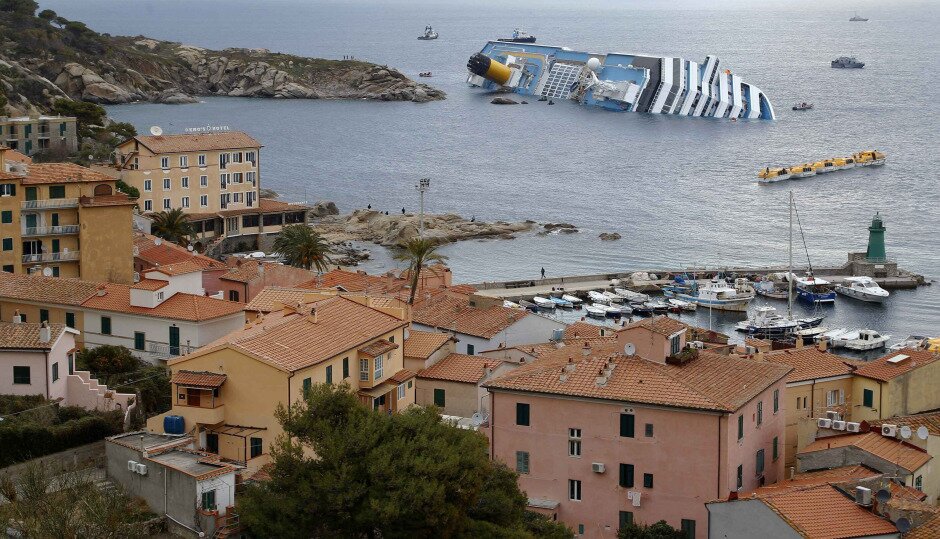
Remember this from early 2012?
The Costa Concordia cruise ship hits a reef and sinks – 32 people die.
I had a post about it back then (Proposed Northern Exit-gateway Pipeline: Accidents happen because of human error… and are not averted due to elaborate statistical analyses…) because ironically enough the Enbridge ‘northern gateway’ pipeline hearings were on in northwestern BC and one Enbridge official (or consultant) was carrying on about the detailed statistical equations they had undertaken, which suggested that the chances of this happening to a massive oil tanker on BC’s coast were: 1 in 15,000 years.
hmmmm…
Here’s the Costa Concordia today – over one and a half years later.

This from a CBC article running today:
Gotta love that media… the ship is still sitting exactly as it is in this picture – e.g., sunk. Yet, the media headline suggests that some Canadian firm actually “helps upright” the ship. Hmmm, maybe the honest headline would be ‘trying to upright’…
So the top picture paints a lovely image. That village has had to put up with a half sunken ship where 32 people died, literally in their front yard for over a year and a half. Probably no oils or fuels leaking… or sewage, or otherwise…
Awesome.
Sure would like to see the ‘statistical analysis’ that predicted the odds of this happening… Probably wasn’t all that different than Enbridge and the Harper gang’s numbers on oil tankers on the BC coast…
Maybe not all that different then the odds that predicted this in Harper’s hometown:
Calgary Saddledome flooded in spring/summer of 2013
Shit happens – no matter what the statisticians suggest.